

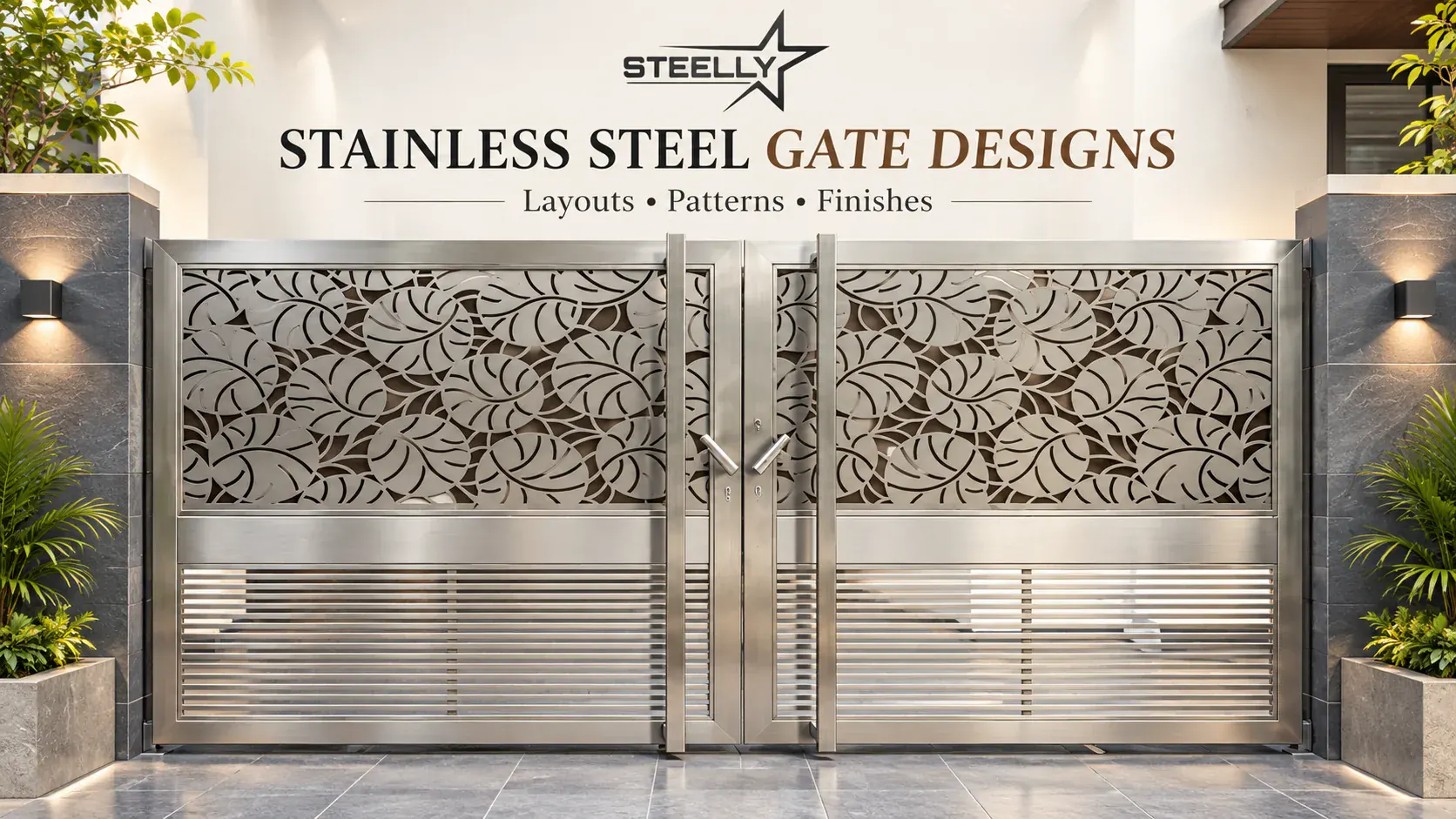
Stainless steel gate designs should be shortlisted around your entrance and daily access. Choosing a stainless steel gate starts with the opening and the way it will be used. A design that looks good in a photograph can be awkward when its leaves block a parking space or its sliding arrangement has nowhere to run. These 15 stainless steel gate design ideas give you distinct options to discuss before committing to fabrication.
The list is a planning guide for Dehradun homes and other entrances, rather than a ranking of tested products. Use photographs as references, then agree your own measurements, material, hardware and installation details. A finish or material grade does not establish the security or structural performance of the complete gate.
What we build most often in Dehradun
At our workshop, the lowest-cost gate design is one made with LX sheet (also called ACP sheet), because LX sheet is the cheapest material option. Beyond that, the design is the customer's choice and depends on their budget — any idea on this list can be made.
We do not turn down designs. What we advise against is SS 202 for a gate that stands outside: for outdoor gates we recommend SS 304. If the budget is tight and the customer still wants SS 202 outdoors, we can make it, but the rust risk then sits with the customer, and we say so before fabrication.
We have many of our own designs to show you, so ask to see them when we visit your site.
15 stainless steel gate design ideas
1. Simple vertical-bar gate
Straight vertical members create a clear, open pattern. This can suit an entrance where visibility and a straightforward appearance matter. Discuss the opening sizes, frame and access needs rather than treating a narrow-looking gap as a safety certificate.
2. Horizontal-bar gate
Horizontal lines can echo balcony rails or a contemporary façade. Compare the bar spacing and the view through the gate from both sides. Where children use the entrance, discuss the climbable pattern along with the rest of the layout.
3. Rectangular grid design
A grid divides the leaf into smaller rectangular spaces and gives the gate a more structured appearance. Keep the proportions tied to the opening rather than simply copying the number of rectangles from a different-sized entrance.
4. Brushed solid-panel gate
A broad brushed panel gives privacy and a quieter visual surface. Confirm whether the selected design uses a sheet, supported panel or other specified construction. Handles and joints should be included in the drawing, not added as an afterthought.
5. Mixed open-and-solid gate
Combine an open upper section with a more private lower section, or reverse the arrangement to suit sightlines. The transition between the two parts can align with the boundary wall. Ask how the infill will be supported and finished.
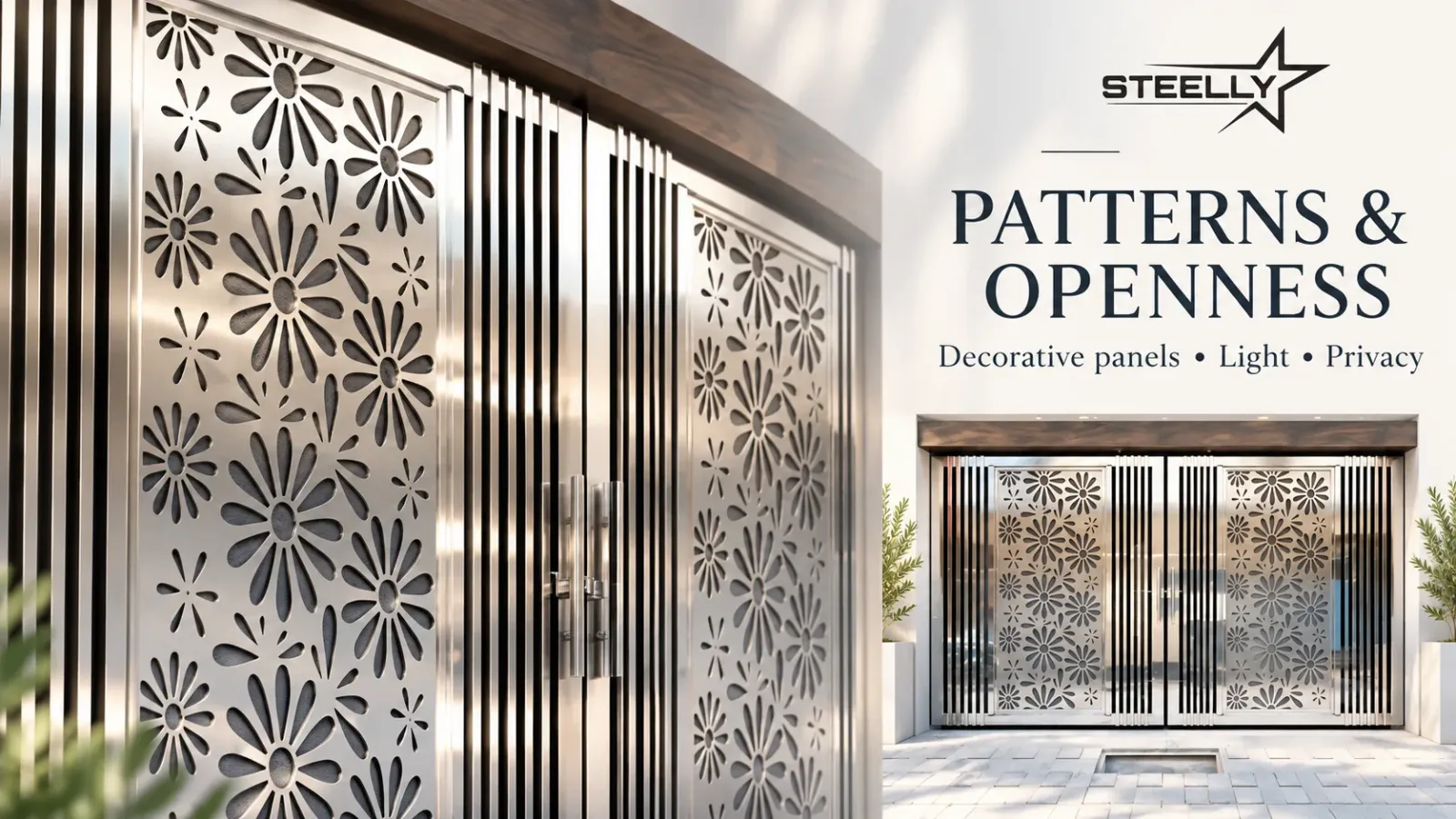
6. Geometric laser-cut panels
Repeating geometric cut-outs can create a strong pattern without traditional ornament. Review the actual cutting drawing and any backing before approval. Pattern density changes privacy and material use, while sharp edges and fixing details still need attention.
7. Floral or leaf-pattern panels
Organic motifs give an entrance a decorative character. Use the owner's reference pattern and check its placement across both leaves. A small sample or approved drawing helps show whether the motif remains readable at the intended scale.
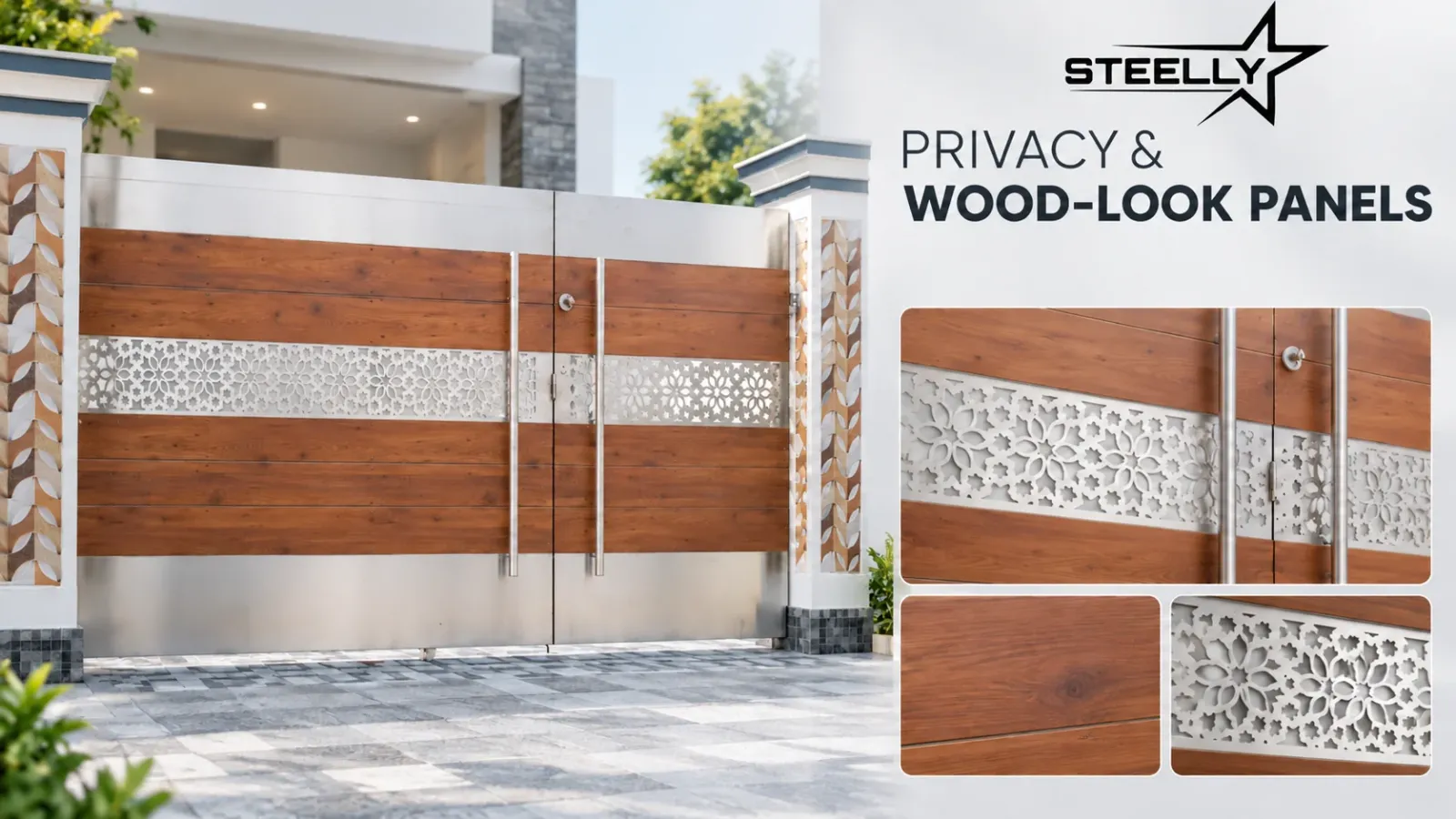
8. A narrow decorative centre band
A single patterned band between plain or wood-look areas offers ornament without covering the entire gate. Align it across the meeting leaves and consider where handles or locks interrupt the pattern. This can be easier to coordinate with a matching pedestrian entrance.
9. Exterior-rated HPL wood-look infill
A stainless steel frame with HPL infill combines metal detailing with a wood-look surface. Confirm the actual exterior-use panel product, colour and fixing arrangement. The term wood-look does not establish a maintenance-free finish or a warranty for every panel.
10. WPC slat infill
WPC slats produce a different surface and joint pattern from a sheet panel. Discuss the selected product, supports, spacing and cleaning requirements. Compare the assembled gate in the drawing; a swatch alone cannot show how the whole entrance will look.
11. Coloured stainless steel frame
A coated frame can coordinate with dark windows or other façade colours. Specify the preparation, coating and sample finish. Keep the material grade separate from the colour description: a black surface does not reveal what metal is underneath.
12. Stainless steel with aluminium profiles
An SS outer frame with aluminium profiles offers another infill arrangement. STEELLY lists this as a separate pricing category. Confirm the chosen profiles and connections, especially where different materials meet; do not compare it with a plain gate solely by headline rate.
13. Matching double-swing leaves
Two balanced-looking leaves create a familiar entrance layout. Their movement needs adequate clear space, suitable supports and stopping arrangements. Symmetry is a visual choice, while the actual leaf sizes depend on the opening and daily use.
14. Unequal leaves with everyday access
A smaller leaf can provide convenient pedestrian access while a larger leaf serves vehicles. Decide how each leaf opens and locks before fabrication. Check the clear walking width and the position of steps, handles and any threshold.
15. A sliding gate with coordinated infill
Many of the patterns above can be discussed in a sliding layout. First check the space beside the entrance, mounting surface and movement arrangement. A sliding gate avoids a swing arc but still needs its own run-back, support and hardware plan.
Narrow the shortlist to your own site
Choose two or three designs that fit the house and your privacy preferences. Then compare them against the entrance movement, road visibility, driveway levels and available space. Include a pedestrian route and any desired automation in the same discussion.
Understand the price
Rates change with grade, design and size, so this guide does not repeat them. For current per-square-foot rates, worked examples for common gate sizes and what the rate includes, see our SS gate price guide. Delivery and site installation are charged separately.
Grade, finish and care
STEELLY recommends SS 304 for its normal exposed outdoor work. The written quotation and bill should identify the selected grade. Request available supplier documentation; a polished appearance or a magnet alone does not verify the material.
Stainless steel still needs cleaning. Follow the published mild-soap care guidance and avoid acids, bleach and steel scrubbers. Inspect moving hardware as instructed. The warranty covers welding joints for 12 months from installation under its terms; material is excluded, and branded hardware has only its maker's applicable cover.
Frequently asked questions
Which design is best for a small entrance?
It depends on movement and available space. Compare a swing layout with a sliding arrangement after checking the opening, driveway and run-back area. A small frontage alone does not select the answer.
Does a designer finish make the gate more secure?
Decoration is not a security rating. The complete frame, supports, fixings and locking arrangement determine how the entrance performs. Ask about the specific assembly being offered.
Get a design and quotation
Send STEELLY your entrance measurements, site photographs and two preferred design references. Mention privacy, everyday walking access and any automation plan. Use the gate designs gallery, current price guide and quality standards to prepare a clear written specification.
Sources reviewed: STEELLY's current SS gate price guide, material-quality guidance and warranty terms. Final rates and construction details are confirmed for the individual project.