

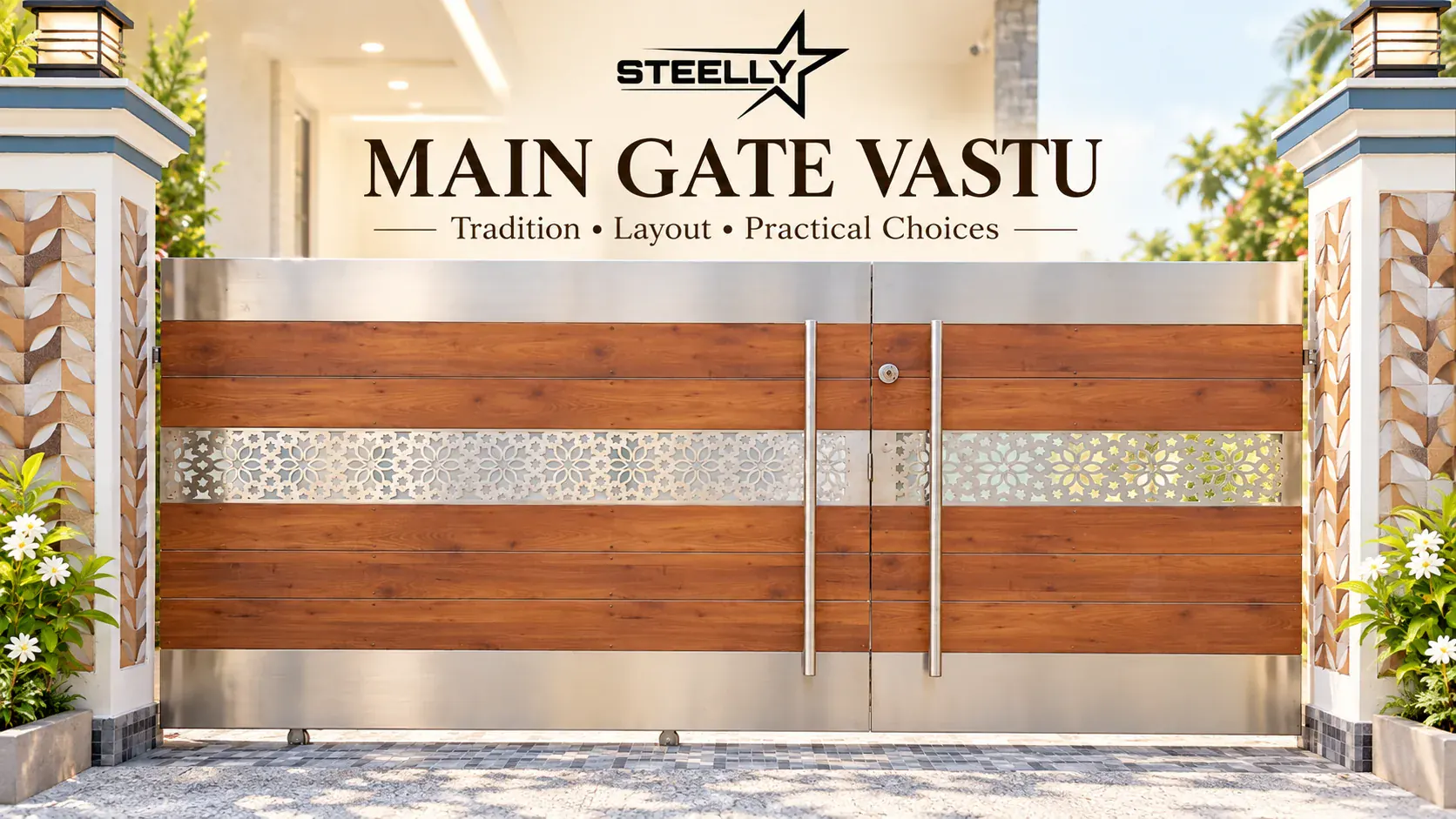
Main gate Vastu is often part of a family’s entrance design brief. A main gate needs to work for the people, vehicles and property behind it. Some families also want its position and appearance to reflect Vastu traditions. Those preferences can be discussed during design, but a compass direction or decorative symbol cannot establish security, structural strength or a guaranteed effect on wealth and health.
This main gate Vastu guide separates cultural choices from practical checks. Use it to prepare a clear brief for your architect and fabricator, especially when replacing an entrance in Dehradun where the existing road, boundary walls and driveway already limit the available options.
What customers ask us about Vastu
At our workshop, the two Vastu questions we hear most are about the gate's direction and its colour. We can make the gate in whatever colour the customer chooses. The colour comes on a sheet that is finished on both sides, and wood-finish sheet is the most popular choice. Any other colour can also be done — it is entirely the customer's choice.
Start with the property, not a direction label
Walk through the entrance as it is used every day. Note the road position, driveway slope, parking space, pedestrian route and the place where a vehicle waits while the gate opens. Photograph both sides of the opening and the supporting walls or pillars.
The main gate in a boundary wall and the main door into the house are different openings. A direction preference for one should not be casually applied to the other. Mark both on the same site drawing so everyone discusses the same entrance.
If you follow a particular Vastu tradition, give its recommendations to the architect before fabrication. Different advisers may interpret a site differently. Treat that advice as a personal or cultural design preference, while keeping practical approval, access and construction requirements in the brief.
Check the direction carefully
An orientation reading taken beside a steel gate, vehicle or electrical equipment may be unreliable. Suunto's compass instructions advise keeping away from metal and magnetic fields when taking readings. They also distinguish magnetic north from true north, which can require a declination correction.
Follow the instructions for your own compass or device. Record where the reading was taken and which north reference is being used. For a building plan, ask the person preparing the drawing to confirm its orientation rather than moving the entrance on the basis of one phone reading.
Choose movement that fits the entrance
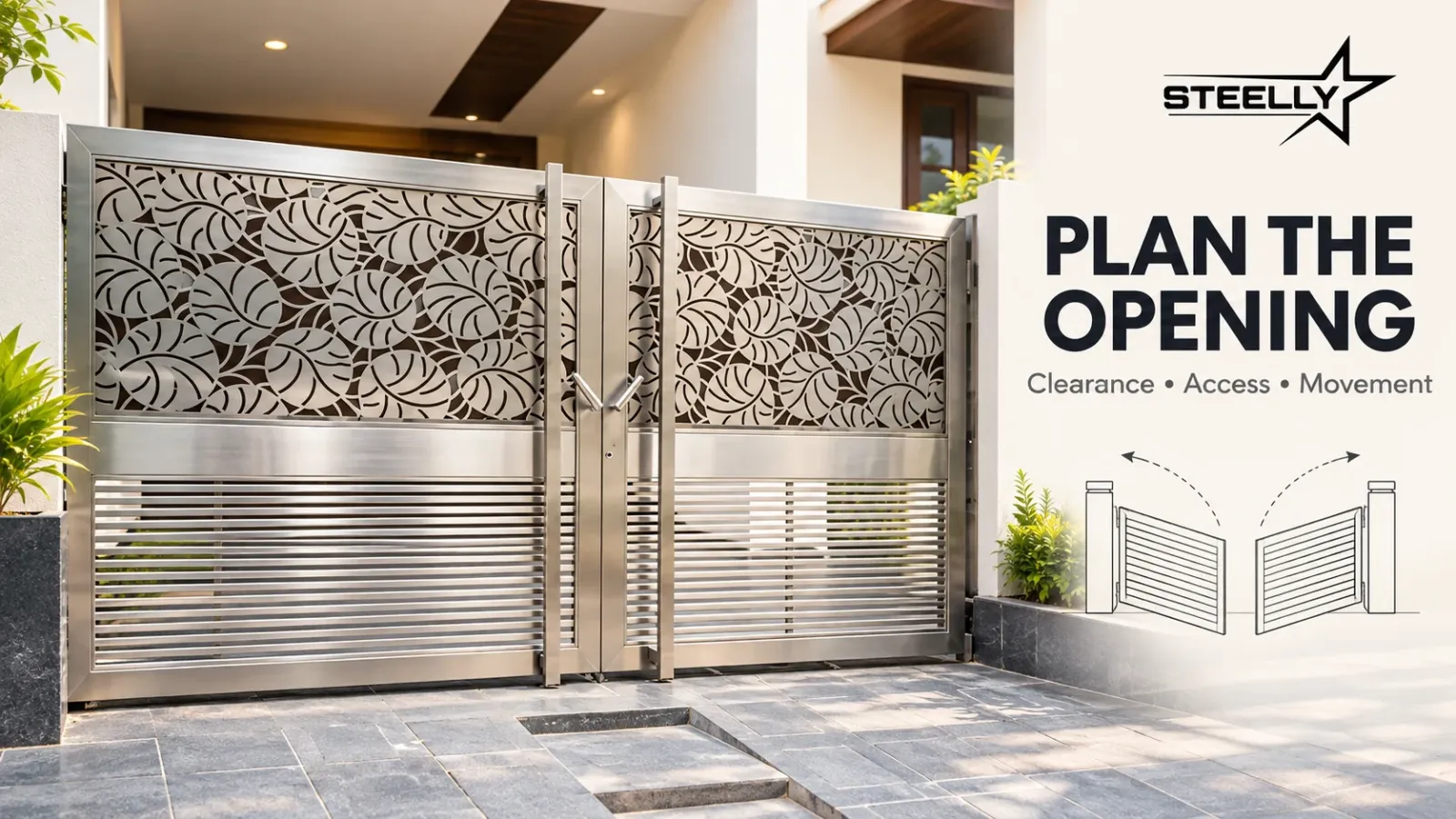
A swing gate needs space for its leaves to move and stop. A sliding gate needs suitable run-back space, support and a practical track or other specified arrangement. Neither choice is automatically right for every narrow plot or sloping driveway.
Check clearance with the gate fully open and closed. Include parked vehicles, paving levels, steps, drains and any nearby door. A pedestrian opening can make everyday access easier, but its position and dimensions belong in the agreed drawing.
Where access or electrical automation matters, resolve those details before the frame is made. A future operator should be discussed with its fitting requirements; the phrase motor-ready does not guarantee that every later system will fit without changes.
Use colour and symbols as design choices
Choose a finish that works with the house, boundary wall and available maintenance. Brushed metal, polished metal, a coloured coating or a wood-look infill can produce very different entrances. Look at a finish sample and a drawing showing the whole gate rather than selecting from a small photograph alone.
Families may prefer a simple nameplate, geometric pattern or familiar auspicious motif. Agree its orientation, size and placement in the design approval. Avoid sharp exposed details or a decoration that interferes with the lock, handles or movement.
Privacy and visibility need their own discussion
Open bars allow views through the entrance. Solid panels or closely arranged infill increase privacy but change the appearance and may affect wind exposure and the weight of the assembly. A decorative cut-out offers another balance, depending on its open area and backing.
Ask for a front drawing that shows the actual pattern. Check sightlines when leaving the property, the position of lighting and the visibility of a nameplate or house number. Consider how visitors communicate with someone inside when the gate is closed.
An attractive panel is not evidence of a tested security rating. Frame construction, supports, fixings and selected locking hardware need to be considered together.

Specify the material and complete price
Gates are priced per square foot of gate area, and the rate depends on the grade and design. For current rates, see our SS gate price guide. STEELLY recommends SS 304 for normal outdoor exposure. Delivery and site installation are charged separately, and automation or other agreed options must be listed in the quotation.
Record the grade, sections, infill, finish and hardware alongside the measurements. Ask for available supplier documentation. Neither appearance nor a magnet test alone establishes the exact stainless steel grade. Read the current SS gate price guide and quality standards before comparing quotations.
Keep the entrance usable after installation
Check that the gate moves smoothly, stops as intended and can be locked without forcing the leaves. Have the installer explain any release mechanism, adjustment or inspection needed for the selected hardware. Keep the approved drawing, quotation and bill.
Clean stainless steel with the mild-soap guidance in STEELLY's care instructions, rinse and dry where practical. Avoid acids, bleach and steel scrubbers. The published warranty covers welding joints for 12 months from installation under its terms; material is excluded and branded hardware has its maker's applicable cover.
Questions before ordering
Is a north-facing gate automatically the best choice?
This guide makes no such guarantee. Discuss any cultural preference alongside the existing road, usable access, construction and approval requirements. A direction label does not establish a suitable gate layout.
Can an existing gate be improved without relocating it?
Often the first useful discussion is its movement, privacy, finish and hardware. An installer needs to assess its condition before recommending alteration or replacement. Moving an opening also involves boundary and site work.
Can STEELLY make a gate from my preferred pattern?
Share a reference, dimensions and site photographs for a feasibility discussion. Confirm the approved design, material and fitting scope in writing before fabrication.
Plan your STEELLY enquiry
Send the entrance width and height, photographs from inside and outside, and your preferred opening style. Add any cultural design requests as a separate part of the brief. STEELLY can then discuss a practical specification and written quotation for your entrance.
Sources reviewed: STEELLY gate pricing, quality standards and warranty; Suunto guidance on obtaining compass readings. Cultural preferences in this article are not presented as scientifically verified predictions.