
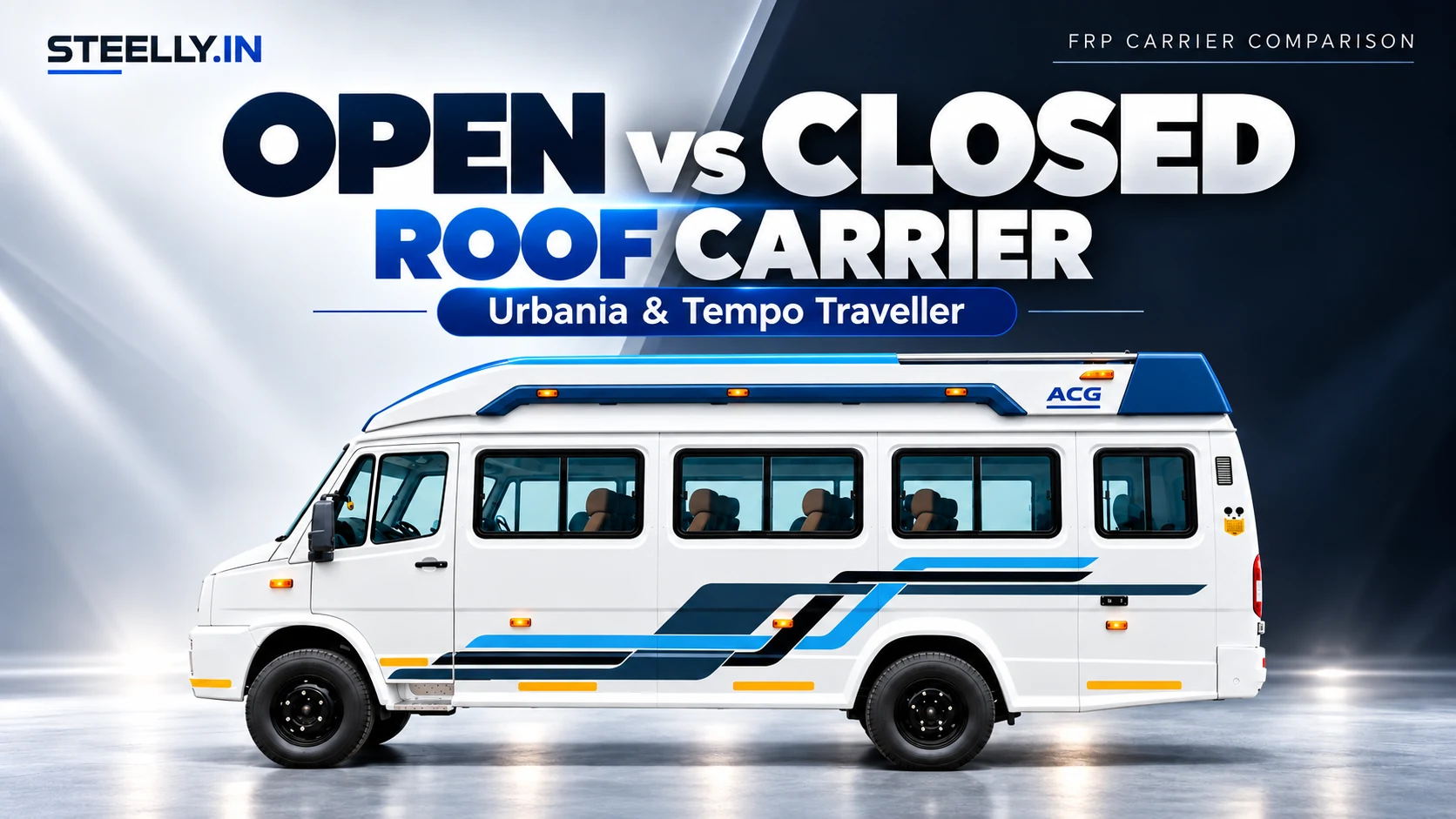
Open roof carrier vs closed FRP carrier: which setup suits an Urbania or Tempo Traveller? The answer depends on luggage access, weather exposure, loading routine and the exact van. This guide compares both designs so tour operators can choose what to ask for before ordering.
Steelly offers made-to-order fibre roof carriers for Force Tempo Traveller and Urbania. The choice between an open tray and closed box is confirmed during enquiry. Use this comparison to discuss the design, dimensions and fitting details for your van in Dehradun.
What is an open roof carrier?
An open tray is a roof-mounted platform or carrier frame where luggage remains visible and accessible from outside. Depending on the specific design, bags may be secured with straps, a cover or another restraint system. Ask the fabricator which accessories and restraints are included; “open tray” alone does not specify them.
This layout can make it simpler to place differently shaped bags or access a particular item without opening a full enclosure. It also means the operator needs a clear loading routine: distribute the bags as advised, secure them properly and check the cover and restraints before every trip.
What is a closed FRP carrier?
A closed carrier uses an enclosure made from fibre reinforced plastic (FRP) around a storage space. Steelly lists fibre carriers for Tempo Traveller and Urbania, made to order and finished to suit the van. A closed design can help shield luggage from direct exposure, subject to how the finished unit is built and maintained.
Do not assume that every closed carrier is fully waterproof or dustproof just because it has a shell. Ask to inspect the lid, openings, seals, closures and drainage details of the actual model. If the supplier offers a water demonstration, see it before handover and get the promised protection in writing.
Open tray vs closed box: practical comparison
| Consideration | Open tray | Closed FRP box |
|---|---|---|
| Access | Bags are exposed and can be reached directly | Access depends on the lid, opening and lock design |
| Cover | Operator may need a suitable cover and restraints | Enclosure is part of the carrier; check the actual seals and closure |
| Mixed bag shapes | Can be easier to arrange irregular items, depending on restraints | Usable space and opening size determine what fits |
| Loading routine | Secure each item and recheck the cover before departure | Close and secure the lid; check that bags do not obstruct it |
| Inspection | Restraints and cover are easy to view | Inspect hinges, locks, seals and inside condition |
| Maintenance | Check frame, finish, straps and cover | Check shell, fasteners, hinges, seals and locks |
| Best fit | Operators who value direct access and can manage secure covering | Operators who prefer an enclosed space and a repeatable loading process |
This is a general comparison. Exact features vary by the carrier design and the vehicle it is made for.
When an open tray may suit your operation
An open tray may be worth considering if your team loads and unloads frequently, carries a changing mix of luggage or wants direct access to individual bags. It can also suit an operator who already has a dependable method for covering and securing luggage.
Before choosing it, check how the actual bags will be restrained. Ask which straps or cover are included, where they attach and how the installer recommends checking them. Think about who will be responsible for checking the load at each stop, especially on multi-pickup routes.
An open carrier does not remove the need to consider wind, rain, dust, bag security or the additional height of a loaded setup. Ask for practical loading instructions specific to the finished carrier.
When a closed carrier may suit your operation
A closed FRP box may suit an operator who wants luggage inside an enclosure and has a consistent set of bags that fits through the access opening. It may be convenient for group tours where luggage remains on the van between stops, subject to the design, mounting and load limits being confirmed for that vehicle.
Check the usable internal dimensions rather than judging capacity from exterior photographs. Measure the largest suitcase you expect to carry and ask whether it can pass through the opening. Confirm how the lid stays open during loading, how it locks and what happens if a hinge or lock needs service.
For a closed design, weather protection depends on the construction and condition of the assembled carrier. Clarify the specific protection offered; do not rely on a broad claim without seeing how the unit closes.
Choose around the trip, not just the appearance
A short airport transfer with repeated luggage stops may reward quick access. A multi-day group tour may make an enclosure attractive if the bags fit and the closure works for the operator. School, wedding, pilgrimage and hotel transport can each bring different combinations of bag sizes, stop frequency and loading staff.
Write down a typical trip before selecting the carrier:
- How many bags are normally carried, and what are their dimensions?
- How often is luggage loaded or removed along the route?
- Who secures or checks it before departure?
- Will the vehicle work in rain, dust or mixed road conditions?
- Does the regular parking area have height restrictions?
- Is quick inspection or locking a priority for the operator?
These questions describe the use case; they do not establish a safe weight or legal clearance for the van. Confirm the limits and conditions for the specific vehicle and installation.
Confirm the vehicle before choosing a design
Urbania and Traveller variants have different body and roof configurations. Force's Urbania range includes 3350 mm, 3615 mm and 4400 mm wheelbase variants. Give the fabricator the exact model, variant, model year and wheelbase, plus clear roof and rear photographs. Seat labels alone may not identify the dimensions of the roof.
Ask the installer to measure the available mounting area and confirm clearances around roof equipment, doors and the rear ladder. Request the proposed carrier's external dimensions, usable internal space where relevant, complete assembly weight and mounting details in writing.
The vehicle manufacturer's guidance and any relevant permit conditions must be checked for the particular van. Do not use a generic roof-box rating or another vehicle's specifications to decide your load.
Questions to ask before placing an order
- Is the quoted design an open tray or a closed box, and what exactly is included?
- What are the external dimensions and usable internal dimensions?
- How will the bags be restrained or the lid secured?
- What is the complete carrier and mounting assembly weight?
- Which vehicle-specific mounting method and load guidance apply?
- Is the rear ladder included, and does it clear the rear doors?
- What maintenance, inspection and warranty terms come with the product?
- What are the price, fitting date and payment stages in the written quote?
Steelly's published van-carrier pages state that products are made to order, with a listed production time of 5–7 days and a ladder included. Confirm these details and all design inclusions against your current quotation.
Explore Steelly's Urbania and Tempo Traveller carriers
Compare the available models and share your van details for a design discussion:
- Tempo Traveller and Urbania carrier range
- Force Urbania 12-seater carrier
- Force Urbania 16-seater carrier
Steelly fabricates and fits these made-to-order options at its Dehradun workshop. For a quote, call +91 74096 66659 and share the exact vehicle details, roof photos and the way you plan to use the carrier.
Frequently asked questions
Is a closed FRP roof carrier automatically waterproof?
Not automatically. Ask about the specific unit's lid, seals, fasteners, test and warranty terms. Inspect the finished carrier and get the supplier's stated protection in writing.
Is an open tray easier to load?
It can provide direct access, but the actual experience depends on tray height, vehicle access, ladder position and the luggage. The load still needs an appropriate restraint and covering routine.
Which option is better for a Char Dham or Uttarakhand tour?
There is no single answer for every operator. Consider how often bags are accessed, what protection the design offers, the exact vehicle and applicable load guidance. Confirm these points with the fabricator before booking.
Can I choose by seater number alone?
No. Confirm the exact variant and wheelbase, then have the roof and mounting area measured for the vehicle being fitted.
For a tailored recommendation, share your trip routine and a roof photo with Steelly before finalising the design.