
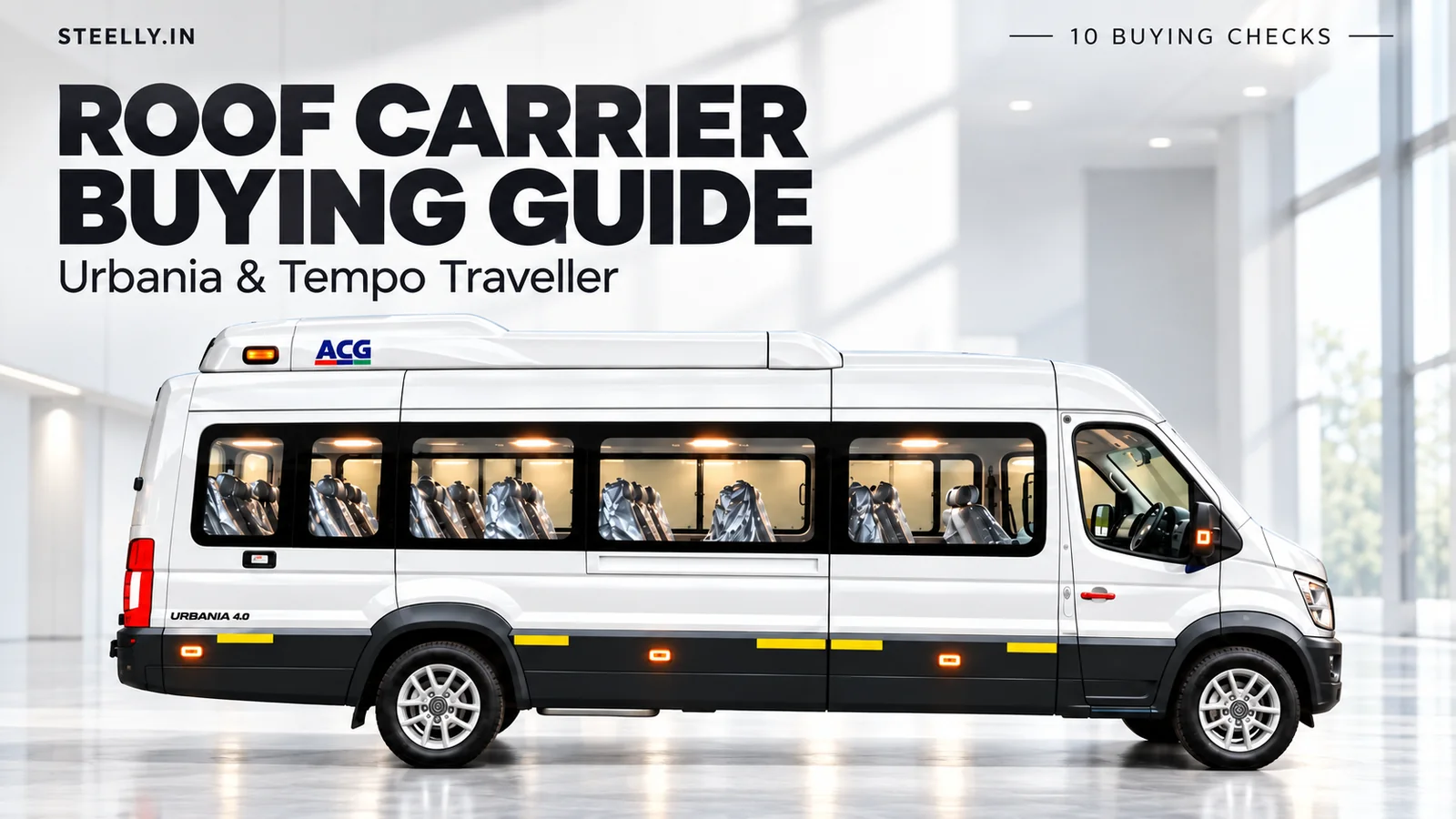
A roof carrier for an Urbania or Tempo Traveller should be selected around the exact vehicle and the luggage it needs to carry. Seat count is a useful starting point, but it does not tell you the usable roof dimensions, mounting requirements or permitted load. Before ordering, ask for a clear specification and a fitting plan for your own van.
This guide is for vehicle owners, tour operators and fleet managers comparing luggage-carrier options. It explains what to check before paying an advance, particularly when preparing a van for airport transfers, group tours or trips from Dehradun and other Uttarakhand towns.
1. Identify your exact vehicle before discussing carrier size
Share the manufacturer, model year, variant and wheelbase with the fabricator, along with clear photographs of the roof and the rear of the van. Mention any existing roof equipment or previous modifications.
A vehicle advertised as a 12-seater does not always have a shorter body than one advertised with more seats. Different seating layouts can be offered on the same wheelbase. For example, Force Motors lists its Traveller N 3700WB with 12/17+D seating configurations. The D represents the driver.
For Urbania, the official website shows 3350, 3615 and 4400 mm wheelbase examples. Current Force listings also include more than one seating configuration on some wheelbases. Confirm the actual van rather than choosing a carrier from an operator's seating label alone.
Wheelbase is the distance between the axles, not the length of the roof or the carrier. The installation area still needs to be measured.
2. Describe the luggage you actually carry
Think about your regular work. Airport passengers with large suitcases have different storage needs from a wedding group carrying small overnight bags. Ask your customers about luggage in advance instead of assuming one identical bag per passenger.
Record typical bag dimensions and the approximate combined weight. A carrier can have enough physical space while the luggage exceeds an applicable weight limit. Conversely, bulky lightweight bags can fill the available volume before reaching that limit.
Ask the supplier to explain usable internal dimensions, the loading opening and any shape that reduces space inside. A photograph of a large carrier is not a measured luggage-capacity specification.
3. Compare an open tray with a closed box
An open tray provides accessible storage, but the load needs suitable restraint and a separate weather-protection arrangement. A closed box encloses the luggage, but its opening, lid clearance, seals and access need checking before you choose it.
Ask to see the design you are ordering. Confirm how bags will be secured, how the lid or cover closes, and which side is used for loading. A closed shell alone should not be treated as proof that the finished assembly will keep out all water or dust.
For Steelly's available van-carrier options, see Tempo Traveller and Urbania roof carriers. The final design and dimensions should be recorded in your quotation.
4. Ask for the complete carrier weight
Request the weight of the finished carrier and its mounting assembly. If the design includes reinforcing members, brackets or other components, those belong in the specification too.
Do not compare two products only by saying one is fibre and the other is steel. The size, construction and complete assembly determine the weight of the product you receive. Ask the supplier what the quoted weight includes and whether it is measured or estimated.
Thule's general roof-box guidance explains that the weight of the rack and empty box must be considered when calculating the remaining allowance for cargo. Its figures for its own products do not establish a load rating for an Urbania, Traveller or a custom Steelly carrier.
5. Confirm the applicable load limits
Ask for the vehicle manufacturer's guidance for your specific model and the load ratings for the proposed carrier and mounting arrangement. These limits need to be considered together; a strong-looking carrier does not by itself establish what the vehicle can carry on its roof.
A load supported while parked is not automatically an acceptable load while driving. Thule distinguishes static and dynamic loading because a moving vehicle encounters braking, acceleration and road impacts.
This article does not assign a kilogram capacity to your van. Obtain vehicle-specific guidance and a documented specification for the installation. Passenger numbers and the vehicle's overall carrying capacity should not be substituted for a verified roof-load allowance.
6. Understand the mounting arrangement
Before booking, ask where the carrier will attach, what hardware will be used and whether any drilling or body work is proposed. Ask how the mounting method is suitable for your vehicle and what inspection or aftercare it requires.
Request clear photographs of an actual comparable installation, including the attachment points. Confirm any questions about vehicle warranty or alterations with the relevant manufacturer or authorised service provider before approving the work.
The useful comparison is between complete fitting proposals, not just the appearance of the carrier shell.
7. Check access and added height
Have the installer check clearance around roof equipment, doors and any opening lid. Discuss ladder placement and rear-door access together, particularly if your daily work requires frequent luggage loading.
Ask for the overall height after installation, including the highest part of the assembly. An open carrier's loaded height may also change with the bags and cover. Keep that information available when planning access to hotel entrances, parking areas and other restricted-clearance locations.
Vehicle dimensions, alteration requirements and permit conditions need separate verification where applicable. Being below a quoted height does not, on its own, establish permission for a particular installation.
8. Inspect weather protection before handover
If weather protection matters for your work, ask how the finished design handles the lid joint, fasteners and other possible entry points. Request a demonstration of the closing arrangement and, where offered, a water test of the actual finished product.
Ask what maintenance the seals and finish require and how damage or leaks would be repaired. Record the protection and warranty that the supplier actually offers rather than relying on general descriptions such as weatherproof.
Keep photographs of the product at handover so the initial condition and agreed fittings are documented.
9. Get ladder, lock and maintenance details in writing
Confirm whether the ladder is included, how it is attached and what usage guidance is supplied. Check that its position works with the rear doors and the intended loading procedure.
For a closed box, ask about locks, spare keys, hinges and replacement parts. For either design, ask when the installer recommends checking the mounts and which signs of movement or damage need attention.
A short handover demonstration is useful: opening and closing the carrier, checking the restraints and understanding the maintenance instructions should be part of receiving the finished installation.
10. Compare complete written quotations
A useful quotation identifies the vehicle and the product being made. It should explain what is included so you can compare proposals fairly.
- Exact vehicle and variant details.
- Agreed carrier dimensions and open or closed design.
- Construction, finish and specified assembly weight.
- Mounting method and applicable documented ratings.
- Ladder, locks and other included accessories.
- Fitting location, expected completion date and payment stages.
- Taxes, transport or other additional charges where applicable.
- Warranty coverage, exclusions and aftercare instructions.
Avoid choosing on the headline price alone when one proposal includes fitting or accessories and another does not.
Planning your Steelly carrier enquiry
Steelly lists made-to-order fibre carrier options for Urbania and Tempo Traveller, with fitting at its Dehradun workshop. Its published van-carrier pages quote a 5–7 day production period, a ladder included and pricing on enquiry. Confirm the current schedule and inclusions in your own written quotation.
Start with the relevant product page, then send the exact model details and roof photographs for assessment:
- Urbania 12-seater carrier enquiries.
- Urbania 16-seater carrier enquiries.
- Tempo Traveller carrier range.
These seating labels help you find the range; actual fitment must still be confirmed against your vehicle. To discuss an installation in Dehradun, call Steelly on +91 74096 66659.
Frequently asked questions
Does every 12-seater Traveller use the same carrier size?
No. Seating alone does not identify the body or usable roof dimensions. Confirm the model, wheelbase and actual measurements before fabrication.
Is a closed carrier automatically waterproof?
Do not assume this from its appearance or material. Ask about the finished assembly's seals, construction, testing and the specific protection the supplier offers.
How many suitcases can an Urbania roof carrier hold?
There is no universal number. Bag dimensions, usable carrier space and the applicable load limits all matter. Ask for measurements and a vehicle-specific assessment.
Can I use a generic roof-box weight limit for my van?
No. Limits quoted for another vehicle or a different manufacturer's product do not establish a rating for your installation.
Sources and further reading
Vehicle specifications checked on 26 September 2026. Variants and equipment may change; verify details for the vehicle being fitted.
- Force Urbania: official variants and seating layouts.
- Force Motors: current variant listings.
- Force Traveller N 3700WB: official specifications.
- Force Traveller N Wider Body 4020WB: official specifications.
- Thule: general roof-box loading guidance.
Steelly is an independent fabricator. References to vehicle manufacturers identify fitment and source information; they do not imply manufacturer approval of an aftermarket installation.