

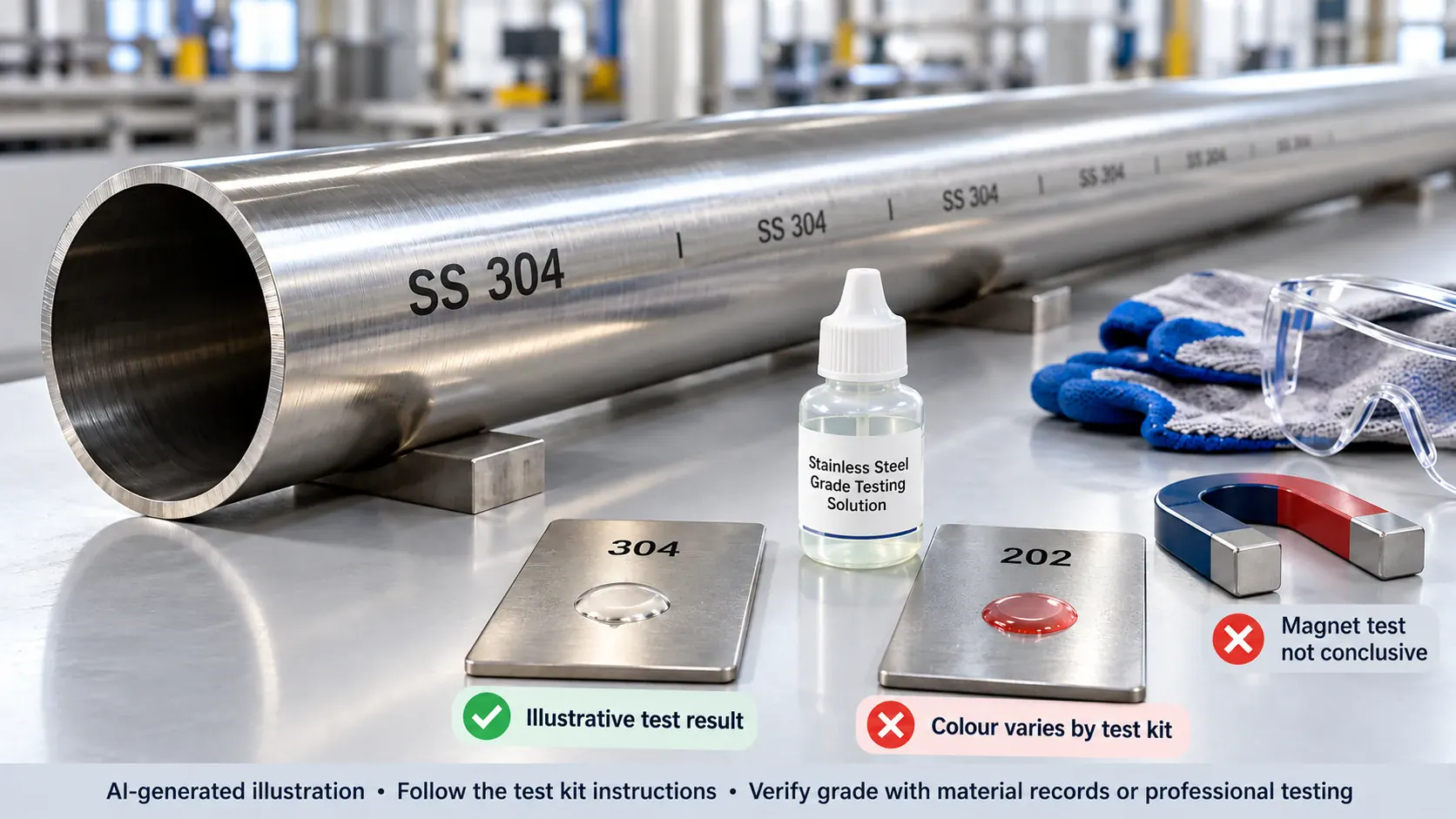
How to check SS 304 is a common question when buying a stainless steel gate or railing. Two polished pipes can look almost identical even when their grades differ. A shiny finish, a printed “304” stamp or a magnet check alone does not confirm what you are buying.
This guide focuses on checking the supplied material. For choosing a grade for your site, read our SS 202 vs SS 304 comparison.
How we check the grade at our Clement Town workshop
At STEELLY we buy stainless steel pipe from a dealer. Before the pipe is cut, we check the grade in two ways:
- **Grade stamp on the pipe.** We look for the grade marking on the pipe body.
- **Testing liquid.** We use a stainless steel testing liquid that is available in the local market. In our experience its result is dependable.
We do not decide the grade with a magnet. In our workshop, genuine SS 304 pipe also pulls slightly towards a magnet, so a magnet on its own tells you very little.
Start with the grade in your written quotation
Before fabrication starts, ask for the grade to be written clearly against the relevant components. “Stainless steel” or “heavy quality” is too vague. If different grades are proposed for different parts, the quotation should explain that instead of describing the entire assembly as SS 304.
The pipe shape, gauge, finish and design should also be clear. A material-grade check does not tell you whether the railing has enough support or the right anchors.
1. Read the pipe marking, but do not treat it as proof
Manufacturer markings can help trace a pipe to its supplier or batch. Photograph the marking before the material is cut and ask the fabricator what the letters and numbers mean. Match the grade shown with the purchase documents where possible.
A stamp is a useful starting point, not an independent chemical test. A missing mark on a short cut piece also does not automatically mean the material is the wrong grade.
2. Ask for material records linked to your order
A supplier invoice records what was bought. A mill test certificate provides more detailed information about a particular batch. Ask whether the records correspond to the material used for your job; a generic certificate for a different batch is less useful.
Small retail purchases may not arrive with individual certificates for every cut length. If the documents are unavailable, discuss an appropriate verification method before paying a premium for a particular grade.
3. Understand the limits of the magnet test
A magnet is not a reliable way to separate SS 202 from SS 304. Both belong to the austenitic stainless steel family. Material condition and forming can affect magnetic response, and genuine 304 may attract a magnet after cold working.
Neither “the magnet does not stick, so it must be 304” nor “it sticks, so the steel is fake” is a safe conclusion. Use magnet response as an observation rather than a grade certificate.
4. Use a suitable chemical test as a screening check
Chemical spot tests can help sort stainless steel, but the result depends on the kit, surface preparation and instructions. There is no universal colour rule for every testing liquid. Do not assume that every red reaction means 202 or that no reaction always proves 304.
Ask a trained person to use a kit intended for the grades being checked. Follow its safety instructions. An unclear result needs further verification, not a confident sales claim.
5. Arrange professional material identification when needed
For a large order or disputed material, ask a competent testing provider about positive material identification (PMI), such as XRF analysis. Confirm the method's scope: an analyser is not a substitute for every laboratory test or every certificate requirement.
Agree beforehand which components will be sampled and how the results will be recorded. Checking one loose sample does not establish that every pipe in the finished assembly has the same composition.
6. Compare quotations with the same specifications
A cheaper quote is not proof of an incorrect grade. Pipe gauge, quantity, design, finish, fittings and installation can also change the price. Compare equivalent specifications before deciding that one supplier is offering the same job for less.
In STEELLY's railing work, 16, 18 and 20 gauge are discussed according to the design and budget. Within the same gauge convention, 16 is thicker than 18 and 20. Confirm the actual supplied specification because grade and gauge describe different properties.
7. Do not identify the grade from stains alone
Red or brown surface spots and loss of shine can appear on stainless steel. Contamination, water exposure, cleaning chemicals and the condition of the finish can contribute. Such marks do not independently identify the alloy.
Do not describe stainless steel as 100% rust-proof. Report the exposure and maintenance conditions to the fabricator and investigate the cause before drawing a conclusion about grade.
Apply these checks to your project
For dry indoor work, SS 202 may be considered when budget matters. For outdoor railings and gates exposed to rain or repeated water contact, STEELLY normally recommends SS 304. SS 304 can also be used indoors when the customer prefers it. The site's environment still matters.
Discuss your stainless steel railing or gate requirement with the grade and gauge written into the specification. For a measured proposal, request a written quote.
Common questions
Can I confirm SS 304 from a photo?
A photo can show markings and visible surface condition, but it cannot establish chemical composition.
Is SS 202 fake stainless steel?
No. It is a different grade. The problem is supplying a different grade from the one agreed and paid for.
Does polish prove quality?
No. Finish, material grade, pipe gauge and installation are separate checks. A bright mirror finish does not establish the alloy.
Technical references
British Stainless Steel Association: on-site grade sorting
British Stainless Steel Association: classification of stainless steels
Illustrative test images, where used, are educational visuals rather than test reports for the material supplied to your project.